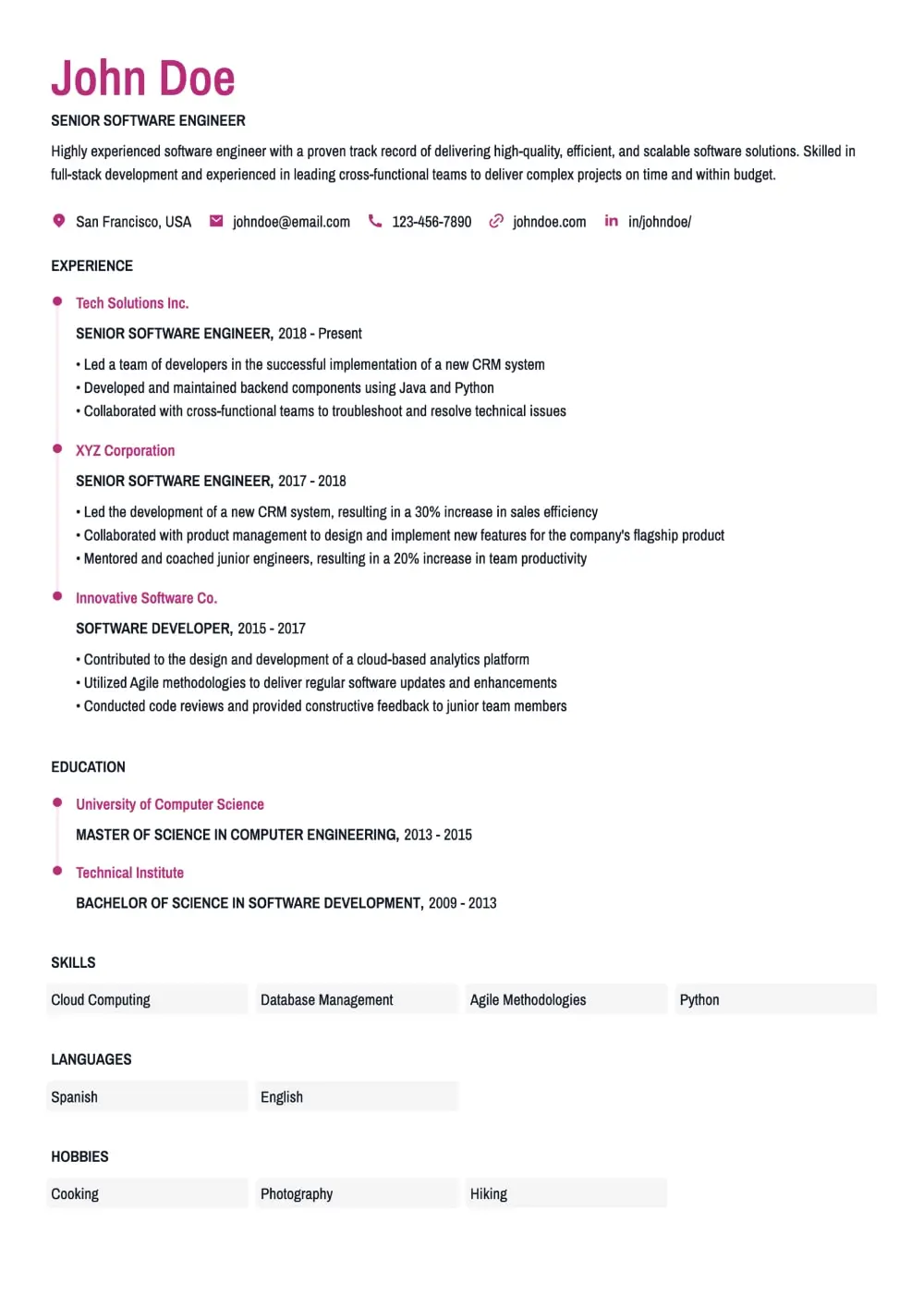
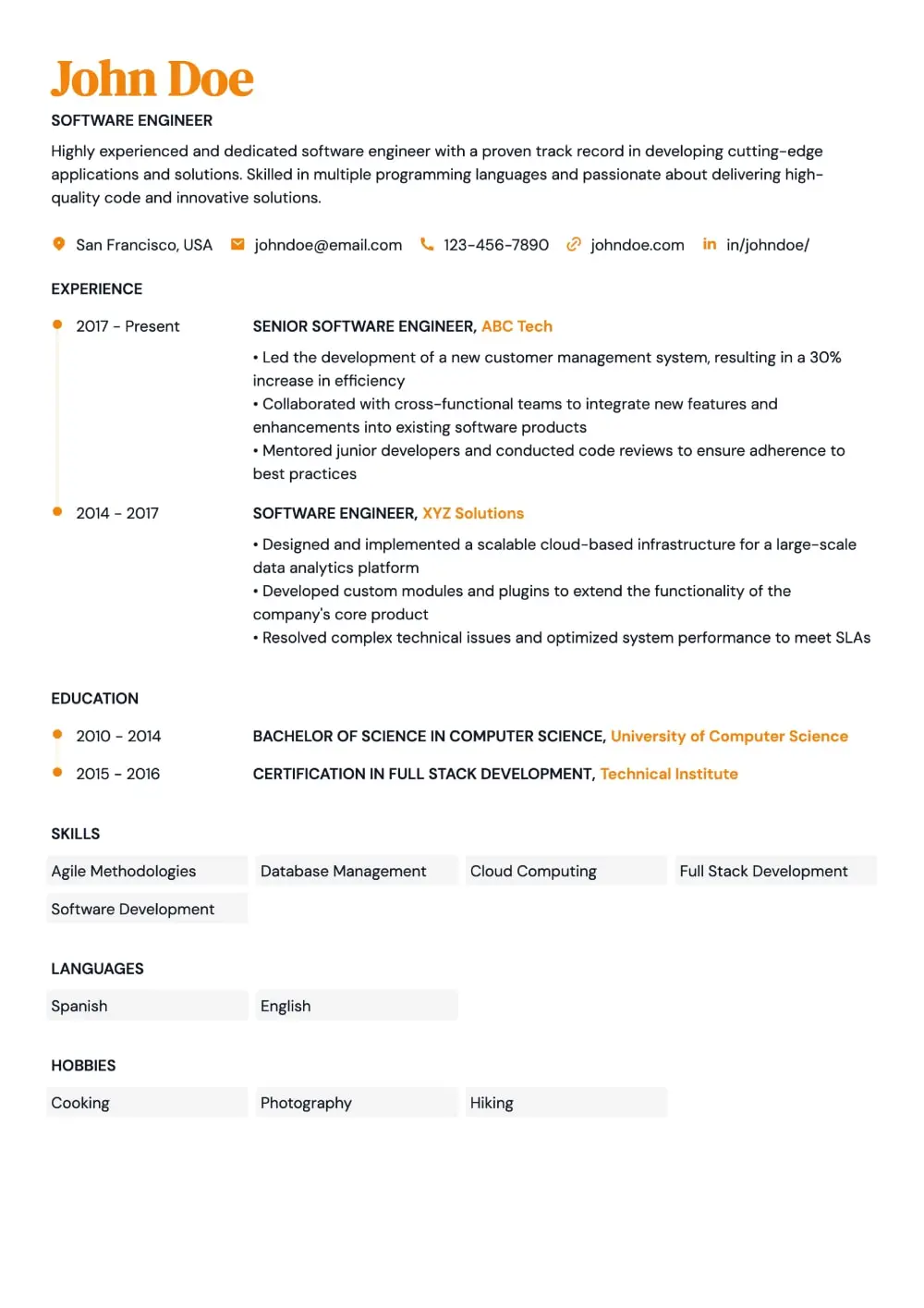
AI at your fingertips: improve, rewrite, shorten, or expand any section of your resume with one click. Instant polish, no guesswork.
Just enter your job title and get a curated list of high-impact bullet points you can pick and apply instantly.
Type your role and choose from tailored summaries and hard skills—perfectly phrased and ready to drop into your resume.
Upload your old resume and our AI will extract, clean up, and modernise it—no need to start from scratch.
Paste the job ad for your dream role and get a CV tailored to it and increase your chances of getting hired.
Create your perfect resume for free. Pay a small fee to download when you’re ready to apply with confidence.
We make sure your CV plays nice with Applicant Tracking Systems, so it gets through the filters and seen by real decision-makers.
Your data stays with you. We don't store your resume information; all of it is saved locally on your device for your peace of mind.
Forget those other complex, time-consuming resume builders. With us, dive right into creating your resume – just easy, quick resume building.
Furthermore, the text provides an in-depth look at the materials used to create membranes, ranging from organic polymers to inorganic ceramics. Understanding the chemical compatibility and mechanical strength of these materials is vital for engineers tasked with selecting the right membrane for harsh chemical environments. The Quest for the Best PDF Resources
Major categories of membrane processes include microfiltration, ultrafiltration, nanofiltration, and reverse osmosis. Each is defined by the pore size of the membrane and the size of the particles or molecules it is designed to reject. Additionally, specialized processes like gas permeation, pervaporation, and electrodialysis extend the utility of membranes to gaseous mixtures and ionic separations. Why Kaushik Nath’s Work is Highly Regarded
Membrane separation processes have revolutionized chemical engineering by providing energy-efficient alternatives to traditional thermal separation methods like distillation and evaporation. When students and professionals search for authoritative resources on this subject, the name Kaushik Nath consistently appears at the top of the list. His comprehensive approach to the theory and practical application of membranes has made his work a cornerstone of modern engineering education. The Principles and Applications of Membrane Separation
For those seeking the "best" PDF resources related to Kaushik Nath’s work, it is important to prioritize legitimate academic platforms and library databases. Digital versions of the textbook are often sought after for their portability and the ability to quickly search for specific technical terms or formulas. Many university libraries provide digital access to the full text, allowing students to study complex diagrams and flowsheets with ease.
One of the standout features of Nath's work is the detailed exploration of reverse osmosis and its role in desalination. As water scarcity becomes a global crisis, the engineering community relies on his clear explanations of osmotic pressure and concentration polarization to design more efficient water treatment systems.
Kaushik Nath, a respected professor and researcher, authored "Membrane Separation Processes," a textbook that is widely considered the gold standard for undergraduate and postgraduate students. The reason readers often look for a PDF version of this specific text is due to its unique pedagogical structure.
Furthermore, the text provides an in-depth look at the materials used to create membranes, ranging from organic polymers to inorganic ceramics. Understanding the chemical compatibility and mechanical strength of these materials is vital for engineers tasked with selecting the right membrane for harsh chemical environments. The Quest for the Best PDF Resources
Major categories of membrane processes include microfiltration, ultrafiltration, nanofiltration, and reverse osmosis. Each is defined by the pore size of the membrane and the size of the particles or molecules it is designed to reject. Additionally, specialized processes like gas permeation, pervaporation, and electrodialysis extend the utility of membranes to gaseous mixtures and ionic separations. Why Kaushik Nath’s Work is Highly Regarded membrane separation processes kaushik nath pdf best
Membrane separation processes have revolutionized chemical engineering by providing energy-efficient alternatives to traditional thermal separation methods like distillation and evaporation. When students and professionals search for authoritative resources on this subject, the name Kaushik Nath consistently appears at the top of the list. His comprehensive approach to the theory and practical application of membranes has made his work a cornerstone of modern engineering education. The Principles and Applications of Membrane Separation Furthermore, the text provides an in-depth look at
For those seeking the "best" PDF resources related to Kaushik Nath’s work, it is important to prioritize legitimate academic platforms and library databases. Digital versions of the textbook are often sought after for their portability and the ability to quickly search for specific technical terms or formulas. Many university libraries provide digital access to the full text, allowing students to study complex diagrams and flowsheets with ease. Each is defined by the pore size of
One of the standout features of Nath's work is the detailed exploration of reverse osmosis and its role in desalination. As water scarcity becomes a global crisis, the engineering community relies on his clear explanations of osmotic pressure and concentration polarization to design more efficient water treatment systems.
Kaushik Nath, a respected professor and researcher, authored "Membrane Separation Processes," a textbook that is widely considered the gold standard for undergraduate and postgraduate students. The reason readers often look for a PDF version of this specific text is due to its unique pedagogical structure.